Showing posts with label custom. Show all posts

Thursday, February 10, 2011

Enabling User to Appear Offline on Microsoft Lync 2010

This blog post is just a follow up/update from Enabling User to Appear Offline on Office Communicator 2007 R2. Almost same post but this one is for Microsoft Lync 2010.

By default, Microsoft Lync 2010 enable users to set their presence to one of the following five states:

But Administrators can provide users with another option for setting their presence: Appear Offline. When a user selects this option, he or she appears to be offline. In fact, all of the user's contacts see a presence icon indicating the user is offline. For the users to have the option of "Appear Offline" you must create a new registry key and registry value on the computer running Microsoft Lync 2010. For this option that I'm showing is per user or machine setting only, not a Global Setting. Caution: Incorrectly editing the registry may severely damage your system. Before making changes to the registry, you should back up any valued data on the computer. Enable User to Appear Offline:

  1. Log on to a computer that is running Office Communicator.
  2. Click Start, and then click Run.
  3. In the Run dialog box, type regedit, and then press ENTER.
  4. In Registry Editor, expand HKEY_LOCAL_MACHINE, expand Software, expand Policies, expand Microsoft, click Communicator.
  5. Right-click the Communicator registry key, point to New, and then click DWORD (32-bit) Value.
  6. After the new value is created, type EnableAppearOffline to rename the value.
  7. Double-click the new EnableAppearOffline registry value.
  8. In the Edit DWORD (32-bit) Value dialog box, type 1 in the Value data box, and then click OK.

    Registry Setting Sample

  9. After making above change, exit from Lync 2010 (from system tray) and relaunch it.
  10. After signing back to Lync 2010 you should able to see "Appear Offline" on the option of the Microsoft Lync 2010.
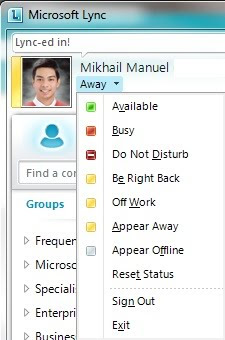
You know have the "Appear Offline" option on Lync 2010.

For question you can email: mikhail@mimanu.com

Configuring Custom Presence States in Microsoft Lync 2010

It's been a while since I post on my blog. I will be posting "Configuring Custom Presence States in Microsoft Lync 2010". Its almost the same process/steps just a bit change on the file location of the application to update from my previous post "Configuring Custom Presence States in Communicator 2007 R2".

Again by default, Microsoft Lync 2010 enable users to set their presence state to one of the following five states and added Appear Offline:To define custom presence states in Microsoft Lync 2010, you will create an XML custom presence configuration file, and then specify its location with the CustomStateURL registry key.
Caution:Incorrectly editing the registry may severely damage your system. Before making changes to the registry, you should back up any valued data on the computer.

Configuration files have the following properties:
  • Custom states can be configured with Available, Busy, and Do Not Disturb.
  • The availability attribute determines which Presence button is associated with the status text of the custom state. In the example below, the status text, Working from Home, is displayed to the right of the Presence button.
  • The maximum length of the status text is 64 characters.
  • A maximum of four custom presence states can be added.
  • Valid address types for the CustomStateURL registry key are FILE:, HTTP:, and HTTPS:
Note:If you implemented a custom presence state URL in previous versions of Communicator by using the CustomStateURL group policy, you might have to modify the URL or change the EnableSIPHighSecurityMode security level so that the custom presence state URL will work in Lync 2010. If the custom state presence URL no longer works, do one of the following:
  • Reformat the custom presence state URL to an encrypted http (https) URL.
  • Set EnableSIPHighSecurityMode group policy to 0.
Configuring Custom Presence States:

  1. Close the Lync and then Create an XML configuration file, by downloading the sample on my Skydrive
  2. Save it to the Lync 2010 Folder. Common Lync 2010 directory is "C:\Program Files\Microsoft Lync". For 64-bit: "C:\Program Files (x86)\Microsoft Lync".
  3. After saving, Launch REGEDIT and look for this directory: HKEY_LOCAL_MACHINE\SOFTWARE\POLICIES\MICROSOFT\COMMUNICATOR
  4. Create a STRING called CustomStateURL and set the following value: C:\Program Files (x86)\Microsoft Lync\Presence.xml
  5. Exit regedit and Relaunch Lync 2010.

Tuesday, June 15, 2010

Configuring Custom Presence States in Communicator 2007 R2 [Updated]

After posting "Enabling User to Appear Offline" I will be posting "Configuring Custom Presence States in Communicator 2007 R2"
Again by default, Office Communicator 2007 R2
enable users to set their presence state to one of the following five states and added Appear Offline:To define custom presence states in Office Communicator 2007 R2, you will create an XML custom presence configuration file, and then specify its location with the CustomStateURL registry key.
Caution:Incorrectly editing the registry may severely damage your system. Before making changes to the registry, you should back up any valued data on the computer.

Configuration files have the following properties:
  • Custom states can be configured with Available, Busy, and Do Not Disturb.
  • The availability attribute determines which Presence button is associated with the status text of the custom state. In the example below, the status text, Working from Home, is displayed to the right of the Presence button.
  • The maximum length of the status text is 64 characters.
  • A maximum of four custom presence states can be added.
  • Valid address types for the CustomStateURL registry key are FILE:, HTTP:, and HTTPS:
Note:If you implemented a custom presence state URL in previous versions of Communicator by using the CustomStateURL group policy, you might have to modify the URL or change the EnableSIPHighSecurityMode security level so that the custom presence state URL will work in Communicator 2007 R2. If the custom state presence URL no longer works, do one of the following:
  • Reformat the custom presence state URL to an encrypted http (https) URL.
  • Set EnableSIPHighSecurityMode group policy to 0.
Configuring Custom Presence States:
  1. Close the Communicator and then Create an XML configuration file, by downloading the sample on my Skydrive
  2. Save it to the Office Communicator Folder. Common Office Communicator directory is "C:\Program Files\Microsoft Office Communicator". For 64-bit: "C:\Program Files (x86)\Microsoft Office Communicator".
  3. After saving, Launch REGEDIT and look for this directory: C:\Program Files (x86)\Microsoft Lync HKEY_LOCAL_MACHINE\SOFTWARE\POLICIES\MICROSOFT\COMMUNICATOR
  4. Create a STRING called CustomStateURL and set the following value: C:\Program Files (x86)\Microsoft Office Communicator\Presence.xml
  5. Exit regedit and Relaunch Office Communicator.
Update:
February 10,2011: Skydrive Link

For other Information:
Configuring Custom Presence States in Microsoft Lync 2010